Research-first. Methods-forward. Built for community action.
This online book presents MPX NYC—an anonymous, web-based study that maps how LGBTQ+ people are connected through the places we share. Using a custom survey platform, participants told us where they lived and where they gathered in settings involving physical contact. From this, we built a city-scale people–place network to explore how patterns of connection shape outbreaks in New York City. For privacy, we recorded only census-tract labels, never exact addresses or spatial coordinates.
In this brief explainer, Dr. Keletso Makofane shares how queer and trans communities built MPX NYC.
MPX NYC was conducted under the Rapid Epidemiologic Study of Sexual Networks, Demographics, and Mpox Infection (RESPND-MI)—a queer- and trans-led collaboration born during the 2022 outbreak. Drawing on lessons from the global HIV movement, we worked fast, shared information openly, and acted collectively.
ACTIONABLE INSIGHTS
Some of what we learned about stopping an outbreak:
Private, not public. Most contact occurs in private homes; outreach limited to sex-positive venues will miss most exposure.
Geographic hubs. Neighborhood clusters act as local and city-wide bridges for connection and spread.
Speed wins. In a choice between vaccinating strategically to limit geographic spread or vaccinating as many people as fast as possible—speed wins.
CAUSAL INFERENCE FOR NETWORKS
This study led us to develop SSNAC—Social and Spatial Network Analysis with Causal Interpretation—a framework extending causal inference methods to account for interconnected populations. SSNAC helps researchers conceptualize, collect, and analyze data about social and spatial networks, not isolated individuals.
Open, accessible science
All code powering this site is public. We invite alliances of LGBTQ+ researchers and activists to adapt it for urgent questions on housing, nutrition, violence, access to care, employment, health, and other areas.
Why this work matters
As funding for LGBTQ+ health services declines—and queer public-health workers face layoffs—we must find new ways to self-organize and use our skills in our own communities. Early in this project, queer and trans New Yorkers joined forces to confront a new threat, showing that epidemiology and community organizing can—and must—coexist.
Through the RESPND-MI LGBTQ+ Community Forum, activists, clinicians, and researchers co-designed the study—refining language, shaping outreach, and building bilingual campaigns. The project became not just a study of networks, but a network itself: a model of participatory, queer-led science grounded in care and trust.
Who we are
This website was developed by Dr. Keletso Makofane, who holds a PhD in Social Network Epidemiology from Harvard University (2021) and an MPH in Biostatistics from Columbia University (2012), awarded under the Fulbright Program. Dr. Makofane is an internationally recognized expert in public health and the global HIV response. His work focuses on the development of methodological innovations in network epidemiology for application in community-based research settings.
The content was drafted through consultation with Nicholas Diamond, MPH; Jennifer Barnes-Balenciaga; Elle Lett, MA, MBiostat, PhD; Ken Mayer, MD; and Nguyen Tran, MPH, PhD, and reflects the cumulative deliberations of the RESPND-MI Investigator Group over a two-year period, with early input from the RESPND-MI Reference Group. The RESPND-MI LGBTQ+ Community Forum provided essential guidance in the preparation of the study, facilitating collective decision-making regarding the study’s design and implementation.
Why self-publish
Because this work is unfunded but urgent, we prioritized making a high-quality, reproducible online book rather than a series of articles in academic journals. Our code and data are freely available, allowing researchers to easily reproduce our methods in order to engage in informed critique. We welcome academic journals and other publications interested in commissioning articles based on this work to contact us.
Impact of MPX NYC
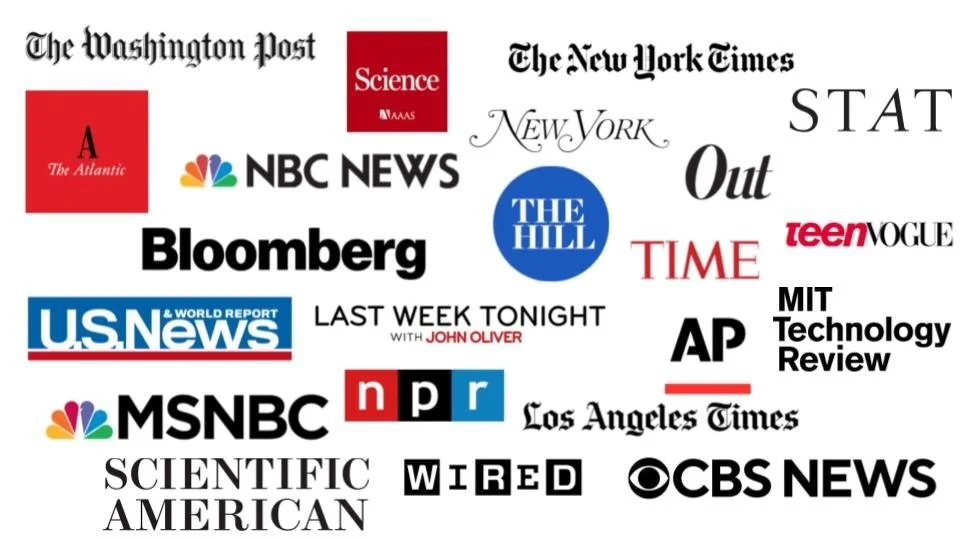
The MPX NYC team’s advocacy and research efforts have been shared through major media outlets: The New York Times, The Atlantic, TIME, PBS NewsHour, CBS News, NPR, The Washington Post, and STAT, as well as queer media such as The Bodyand POZ Magazine. International coverage in PLOS Global Public Health, Out, and The Sunday Times further extended the reach.
These stories shaped national conversations on health equity, stigma, and queer-led public health—positioning RESPND-MI as a trusted voice bridging science, activism, and policy in real time during the mpox emergency.
RESPND-MIPrincipal investigator: Keletso Makofane, MPH, PhD. Co-investigators: Jennifer Barnes-Balenciaga, Nicholas Diamond, MPH, Elle Lett, PhD, MA, MBiostat, Cody Nolan, MD, Martez Smith, LMSW, PhD, Nguyen Tran, MPH, PhD. Former investigators: Pedro Botti Careneiro, MPH, PhD, Seema Kara, MPH, James Krellenstein, Ken Nadolski, MPH, Joseph Osmundson, PhD, Robert Pitts, MD, Grant Roth, MPH, Sudipta Saha, MS, Christian Urrutia, MBA, Chris Wyman. Translator: Antón Castellanos Usigli, MPH, DrPH. Backend web developer: Imran Ansari. Reference group: Judith D. Auerbach, PhD (University of California, San Francisco), Lisa Berkman, PhD (Harvard University), Forrest W. Crawford, PhD (Yale University), William C. Goedel, PhD (Brown University), Gregg Gonsalves, PhD (Yale University), Ian W. Holloway, PhD, LCSW, MPH (University of California, Los Angeles), Louise Ivers, MB, BCh, MD, MPH, DTMH (Massachusetts General Hospital), Lawrence C. Long, MCom, PhD (Boston University), Kenneth Mayer, MD (The Fenway Institute), Gregorio Millett, MPH (amfAR), Eric J. Tchetgen Tchetgen, PhD (University of Pennsylvania). Research sponsors and funders: amfAR; Harvard Center for AIDS Research; National Institutes of Health; Neo4j; New York State Department of Health. Marketing sponsors and funders: Grindr; Hub for Health Intervention, UCLA Luskin School of Public Affairs. Marketing agency: Burness. Administration: Christian Urrutia, MBA (PrEP4All); James Krellenstein (PrEP4All).
CONTACT Keletso Makofane (keletso@controlf.info). Nicholas Diamond (nick@controlf.info). Ctrl+F.
SUGGESTED CITATION Makofane, K., Diamond, N., Barnes-Balenciaga, J., Lett, E., Mayer, K., Tran, N. (2025). Community and connection: A study on social connection among LGBTQ+ New Yorkers. Ctrl+F on behalf of RESPND-MI. New York City. Available: https://mpxresponse.org
ACKNOWLEDGEMENTS We thank PrEP4All for generous administrative support; our individual donors; Kenneth Mayer, Eric Tchetgen Tchetgen, and John Diamond for creating the conditions for this work; members of the RESPND-MI Community Forum and Reference Group for suggestions from fundraising to study design; and the LGBTQ+ people who gave time and care in crisis. We dedicate this work to those who responded—and those who will respond next.